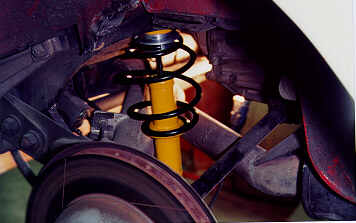
One of the things that we enjoyed the most about this car is in the designing the suspension components from less costly after market parts, or factory components that were much less costly than the factory's Koni adjustable setup. The sway bars proved to be the biggest headache, but well worth the effort. We utilized a straight hollow sway bar with alloy arms that splined to the sway bar on each end. One of the greatest challenges of this part of the suspension design was that I wanted to use the same size bar on both front and rear of the car. The torsion rate is controlled by the wall thickness of the tubing. The front bar is 1.25 diameter with a .125 wall thickness. The rear is the same OD and length as the front but has a .090 wall thickness.

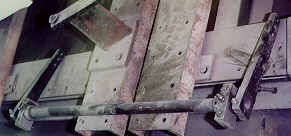
The alloy arms have multiple holes in the ends for fine tuning the bars. We then fabricated and machined a set of mounts for the sway bars. 3/8 inch spherical rod ends are used to connect the sway bars to the control arms. We have multiple holes in the control arms to allow for fine-tuning of the spring rate of the torsion bars. We temporarily used a set of Weltmeister 250lb progressive rate springs on the stock 944 turbo struts until we developed our own design struts.
During the first summer we ran the car, we were constantly making these upgrades, we would go to an auto cross or track event and field test the improvements we were doing. The springs and sway bars made a 4-second difference in the auto cross times and well worth the effort.
Over the winter of 97-98, we developed our own adjustable strut using the features from both the 944 Turbo and the 930 Turbo (Bilstein) and did a final third generation lower control arm. Our original designs supported the car for the first year auto crossing and track events, but we felt we could make small improvements during the cars down time for a final product. Pictured here are the final version control arms.
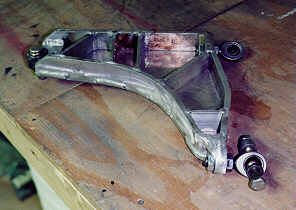
We wanted to have a front strut that was easily re-valveable, ultra strong and with an adjustable spring perch. The Bilstein upside down design strut cartridge used in the 930 Turbo was a very attractive idea, but there were height and diameter differences that took a little time to overcome. We utilized 930 Turbo Bilstein strut housings, used of course, and cut the 930 spindle off of the tube and used the spindle clamp off the 944 strut and welded it to the 930 housing. We installed a new set of Bilstein inserts (which by the way Bilstein will re-valve them to your car's weight, swaybar and spring rate for a modest cost). One thing we discovered in this undertaking was that every manufacturer uses different methods of measuring their springs. Personally, I think it's to keep us all confused. We measured the Weltmeister springs at the ride height we measured on the car (10") and discovered that they actually measured around 160 pounds at that height. We used 250lb non-progressive, 12" long springs from the aftermarket. This was a 50% increase, which seemed like a good starting point. The struts had 3-1/2" of travel at the strut (slightly more at the tire) and proved adequate for track use. This might not be enough travel for street use or with a weaker spring. After market camber plates could not be used because the stud at the top of the Bilstein strut was larger than the 944Turbo.

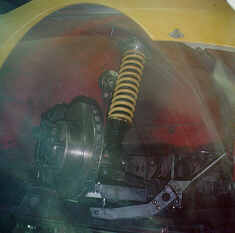
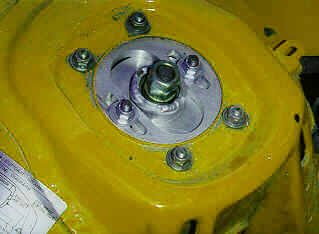
We fabricated a spherical bearing camber plate of our own design. The weight of the car is supported on flat roller bearings just above the coil springs. This system allows for easy track adjustable camber settings.
We selected a Koni coil over shock for the rear. This carries a Porsche part number from the M030 performance options. This combination was intended to be used with the stock 26mm rear torsion bar. Another option would have been to use a larger diameter rear torsion bar. The addition of the coil springs significantly raised the back of the car thus requiring us to lower it by the torsion bars. We rotated the shaft 2 teeth on the outer spline. There are 44 splines on the outer side. This changed the geometry 16.4 degrees or approximately 3". Since the spring on the shock would now be supporting some of the weight, we ended up lowering it about 2" when completed. As you can see by the photos, the car has a very low ride height.